
Historic District Commission
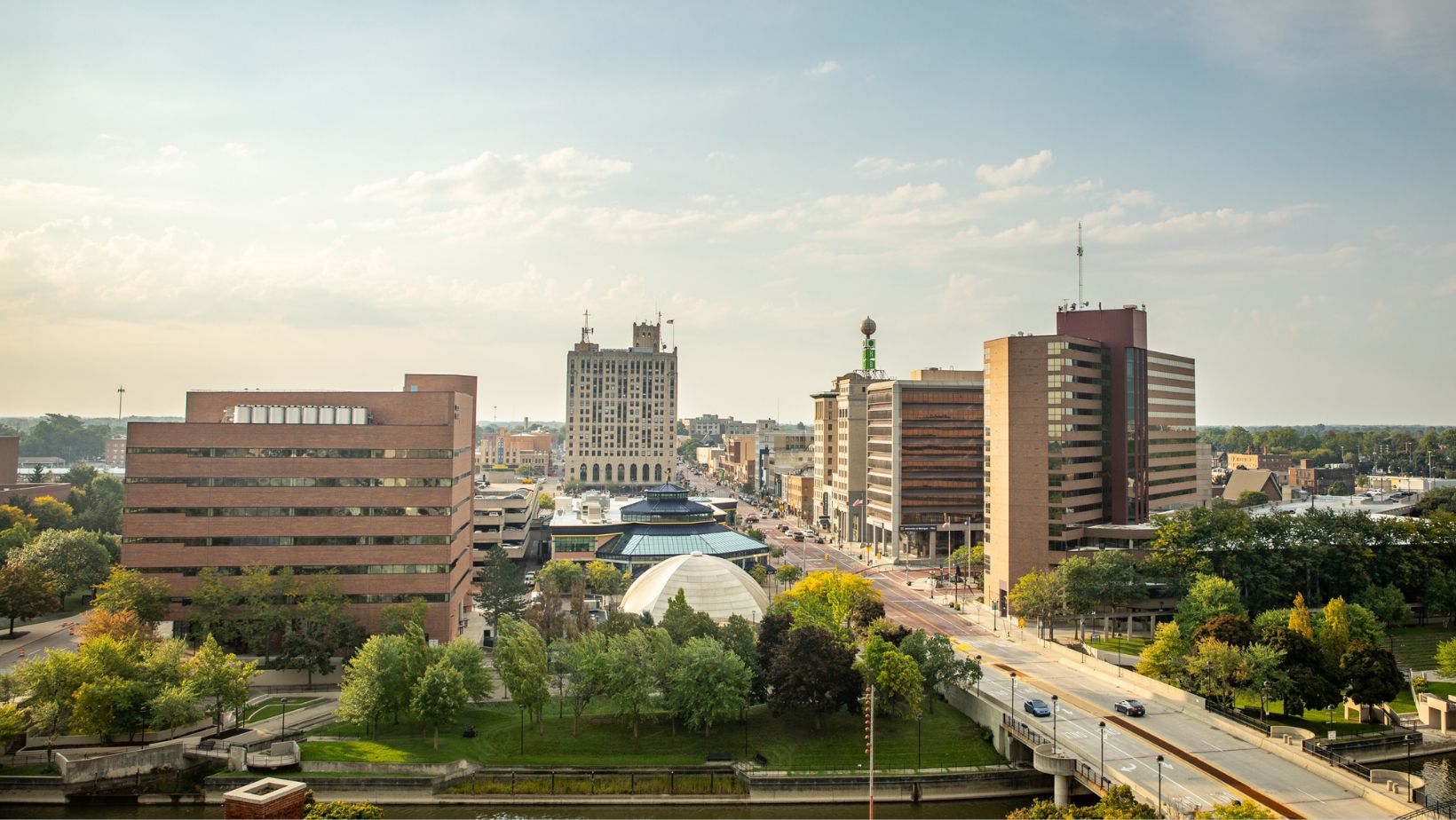
The Historic District Commission reviews proposals for additions, alterations, or other changes to structures within the City’s historic districts.
Regular meetings are held on the first Thursday of each month. The public may attend the meetings in person or via Zoom using the information below.
https://us02web.zoom.us/j/87666094293
Meeting ID: 876 6609 4293
Dial by your location: +1 312 626 6799
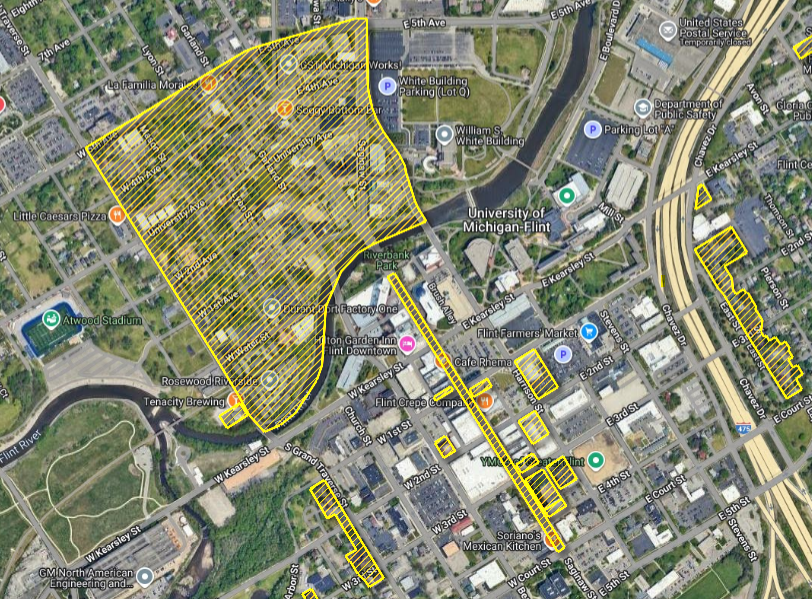
Local Historic Districts and Properties Viewer
The City of Flint Parcel Hub has been updated to display the location of local historic districts and properties. The “Flint Local Historic Districts” layer is turned on by default and appears as bright yellow diagonal lines overlaid onto the map. Please note that this data has been created by staff using the descriptions found in §2-143 and available plat maps. This data is not intended to show the exact location of each overlay district, but instead to show the general properties and areas that are classified as a locally historic and subject to the provisions of the local historic district ordinance.
HDC Application Information
Application Review Fees (effective 7-1-24):
- Residential – $20
- Commercial/Non-Residential – $50
Applications for commercial/non-residential buildings must include drawings signed and sealed by a registered engineer, architect or surveyor. Commercial/non-residential buildings include residential properties with a capacity of four or more units.
Applications are reviewed based on the Secretary of the Interior’s Standards for the Treatment of Historic Properties. Depending on the work being proposed, standards may relate to Preservation, Rehabilitation, Restoration, and/or Reconstruction. These standards are provided below with links to their respective National parks Service webpage.
Local Historic DIstricts Act
The City of Flint Historic District Commission is enabled by the Michigan Local Historic Districts Act, being Act 169 of 1970 as amended, MCL 399.201 et. seq. The act is linked below.
In addition to establishing the authority of the HDC, the act also defines the scope of reviews for Certificates of Appropriateness and Notices to Proceed. Standards of review for a Notice to Proceed can be found in MCL 399.205(6).
Secretary of the Interior's Standards for the Treatment of Historic Properties
Rehabilitation as a Treatment
Rehabilitation is defined as the act or process of making possible a compatible use for a property through repair, alterations, and additions while preserving those portions or features which convey its historical, cultural, or architectural values.
Standards for Rehabilitation
- A property will be used as it was historically or be given a new use that requires minimal change to its distinctive materials, features, spaces and spatial relationships.
- The historic character of a property will be retained and preserved. The removal of distinctive materials or alteration of features, spaces and spatial relationships that characterize a property will be avoided.
- Each property will be recognized as a physical record of its time, place and use. Changes that create a false sense of historical development, such as adding conjectural features or elements from other historic properties, will not be undertaken.
- Changes to a property that have acquired historic significance in their own right will be retained and preserved.
- Distinctive materials, features, finishes, and construction techniques or examples of craftsmanship that characterize a property will be preserved.
- Deteriorated historic features will be repaired rather than replaced. Where the severity of deterioration requires replacement of a distinctive feature, the new feature will match the old in design, color, texture and, where possible, materials. Replacement of missing features will be substantiated by documentary and physical evidence.
- Chemical or physical treatments, if appropriate, will be undertaken using the gentlest means possible. Treatments that cause damage to historic materials will not be used.
- Archeological resources will be protected and preserved in place. If such resources must be disturbed, mitigation measures will be undertaken.
- New additions, exterior alterations, or related new construction will not destroy historic materials, features, and spatial relationships that characterize the property. The new work will be differentiated from the old and will be compatible with the historic materials, features, size, scale and proportion, and massing to protect the integrity of the property and its environment.
- New additions and adjacent or related new construction will be undertaken in such a manner that, if removed in the future, the essential form and integrity of the historic property and its environment would be unimpaired.
See nps.gov for more information.
Preservation as a Treatment
Preservation is defined as the act or process of applying measures necessary to sustain the existing form, integrity, and materials of an historic property. Work, including preliminary measures to protect and stabilize the property, generally focuses upon the ongoing maintenance and repair of historic materials and features rather than extensive replacement and new construction. New exterior additions are not within the scope of this treatment; however, the limited and sensitive upgrading of mechanical, electrical, and plumbing systems and other code-required work to make properties functional is appropriate within a preservation project.
Standards for Preservation
- A property will be used as it was historically, or be given a new use that maximizes the retention of distinctive materials, features, spaces and spatial relationships. Where a treatment and use have not been identified, a property will be protected and, if necessary, stabilized until additional work may be undertaken.
- The historic character of a property will be retained and preserved. The replacement of intact or repairable historic materials or alteration of features, spaces and spatial relationships that characterize a property will be avoided.
- Each property will be recognized as a physical record of its time, place and use. Work needed to stabilize, consolidate and conserve existing historic materials and features will be physically and visually compatible, identifiable upon close inspection and properly documented for future research.
- Changes to a property that have acquired historic significance in their own right will be retained and preserved.
- Distinctive materials, features, finishes and construction techniques or examples of craftsmanship that characterize a property will be preserved.
- The existing condition of historic features will be evaluated to determine the appropriate level of intervention needed. Where the severity of deterioration requires repair or limited replacement of a distinctive feature, the new material will match the old in composition, design, color and texture.
- Chemical or physical treatments, if appropriate, will be undertaken using the gentlest means possible. Treatments that cause damage to historic materials will not be used.
- Archeological resources will be protected and preserved in place. If such resources must be disturbed, mitigation measures will be undertaken.
See nps.gov for more information.
Restoration as a Treatment
Restoration is defined as the act or process of accurately depicting the form, features, and character of a property as it appeared at a particular period of time by means of the removal of features from other periods in its history and reconstruction of missing features from the restoration period. The limited and sensitive upgrading of mechanical, electrical, and plumbing systems and other code-required work to make properties functional is appropriate within a restoration project.
Standards for Restoration
- A property will be used as it was historically or be given a new use that interprets the property and its restoration period.
- Materials and features from the restoration period will be retained and preserved. The removal of materials or alteration of features, spaces and spatial relationships that characterize the period will not be undertaken.
- Each property will be recognized as a physical record of its time, place and use. Work needed to stabilize, consolidate and conserve materials and features from the restoration period will be physically and visually compatible, identifiable upon close inspection and properly documented for future research.
- Materials, features, spaces and finishes that characterize other historical periods will be documented prior to their alteration or removal.
- Distinctive materials, features, finishes and construction techniques or examples of craftsmanship that characterize the restoration period will be preserved.
- Deteriorated features from the restoration period will be repaired rather than replaced. Where the severity of deterioration requires replacement of a distinctive feature, the new feature will match the old in design, color, texture and, where possible, materials.
- Replacement of missing features from the restoration period will be substantiated by documentary and physical evidence. A false sense of history will not be created by adding conjectural features, features from other properties, or by combining features that never existed together historically.
- Chemical or physical treatments, if appropriate, will be undertaken using the gentlest means possible. Treatments that cause damage to historic materials will not be used.
- Archeological resources affected by a project will be protected and preserved in place. If such resources must be disturbed, mitigation measures will be undertaken.
- Designs that were never executed historically will not be constructed.
See nps.gov for more information.
Reconstruction as a Treatment
Reconstruction is defined as the act or process of depicting, by means of new construction, the form, features, and detailing of a non-surviving site, landscape, building, structure, or object for the purpose of replicating its appearance at a specific period of time and in its historic location.
Standards for Reconstruction
- Reconstruction will be used to depict vanished or non-surviving portions of a property when documentary and physical evidence is available to permit accurate reconstruction with minimal conjecture and such reconstruction is essential to the public understanding of the property.
- Reconstruction of a landscape, building, structure or object in its historic location will be preceded by a thorough archeological investigation to identify and evaluate those features and artifacts which are essential to an accurate reconstruction. If such resources must be disturbed, mitigation measures will be undertaken.
- Reconstruction will include measures to preserve any remaining historic materials, features, and spatial relationships.
- Reconstruction will be based on the accurate duplication of historic features and elements substantiated by documentary or physical evidence rather than on conjectural designs or the availability of different features from other historic properties. A reconstructed property will re-create the appearance of the non-surviving historic property in materials, design, color and texture.
- A reconstruction will be clearly identified as a contemporary re-creation.
- Designs that were never executed historically will not be constructed.
See nps.gov for more information.
Historic District Commission Applications
Interest form for Department of Business and Community Services Boards and Commissions.
| Resource | Description | Actions |
|---|---|---|
| Certificate of Appropriateness Application | Applications are reviewed based on the Secretary of the Interior’s Standards for the Treatment of Historic Properties. Depending on the work being proposed, standards may relate to Preservation, Rehabilitation, Restoration, and/or Reconstruction. Updated 2.5.26 | Open file (new tab) Download |
| Notice to Proceed Application | Use this application for ALL demolition requests and requests for work that do not comply with the Secretary of the Interior's Standards for the Treatment of Historic Properties. A Notice to Proceed may be approved for projects that do not meet all standards for a Certificate of Appropriateness but meet the requirements of Sec. 5 of the Local Historic Districts Act, being Act 169 of 1970. Updated 2.5.26 | Open file (new tab) Download |
| Board-Commission Interest Form | Interest form for Department of Business and Community Services Boards and Commissions. | Open file (new tab) Download |
Historic District Commission Documents
| Resource | Description | Actions |
|---|---|---|
| 2026 HDC Meeting Schedule | 2026 Historic District Commission Meeting Schedule. | Open file (new tab) Download |
| Historic District Commission Roster | Open file (new tab) Download | |
| Guide to Development | A document detailing the various application review processes within the Department of Planning and Development. | Open file (new tab) Download |
| Public Participation Plan | A document designed to provide a framework for determining the appropriate type and amount of public participation required for various purposes, and also to identify a variety of communication and participation strategies that are appropriate based on the intended audience. This document applies to those bodies under the purview of the Department of Planning and Development. | Open file (new tab) Download |
| HDC By-Laws | Open file (new tab) Download | |
| Historic District Ordinance – Chapter 2, Article XIX | Open file (new tab) Download | |
| Secretary of the Interior’s Standards | Open file (new tab) Download |
Miscellaneous Documents
Digitized copy of the Civic Park Home Preservation Manual developed in 1981 by Tomblinson, Harburn, Yurk & Associates and William Kessler & Associates. This document was funded by a grant from the Charles Stewart Mott Foundation and prepared for the Flint Neighborhood Improvement and Preservation project, Inc. and the City of Flint.
| Resource | Description | Actions |
|---|---|---|
| Flint FLASH Project Website | The Flint Archaeology and Spatial History (FLASH) project invites people to explore Flint – from its first human inhabitants through today's communities – using data gathered by archaeologists, historians and geographers… The FLASH project has three facets: it is a digital research infrastructure, a collaborative research group, and a public portal for exploring Flint’s past. FLASH grew from an initial collaboration in 2019 between archaeologist Sue Alcock and archaeologist/historical GIS researcher Dan Trepal to construct a spatial, digital historical atlas of Flint showcasing underrepresented aspects of Flint's history. | Open file (new tab) Download |
| Carriage Town Resurvey 1994-1995 | Resurvey report from 1994-1995 of the Carriage Town local historic district. | Open file (new tab) Download |
| Carriage Town Master Plan (1984) | Digitized copy of the Carriage Town Master Plan created in 1984 by by Tomblinson, Harburn, Yurk & Associates and Townscape Institute Public Art Planners. This document was funded by a grant from the Charles Stewart Mott Foundation, Ruth Mott Fund, the Flint Public Trust, and the City of Flint. The Carriage Town Master Plan was developed for the City of Flint Department of Community Development. | Open file (new tab) Download |
| 1983 Historic Flint Survey | Document scan of surveys and/or historic district nomination forms for Carriage Town, Glenwood Cemetery, Grand Traverse South, Chevrolet Park, and Woodlawn Park. Circa 1983. | Open file (new tab) Download |
| Report for 1982 Flint Survey S82-168 | Report from the 1982 survey of various areas to be nominated as local historic districts including East Street, Central Business District Area, Grand Traverse South, and Carriage Town. | Open file (new tab) Download |
| A Land Use History and Preliminary Cultural Resource Survey of the Water Street District (1982) | Digitized copy of A Land Use History and Preliminary Cultural Resource Survey of the Water Street District created in 1982 by Caminos Associates. This document was developed for the City of Flint Department of Community Development. | Open file (new tab) Download |
| Civic Park Home Preservation Manual (1981) | Digitized copy of the Civic Park Home Preservation Manual developed in 1981 by Tomblinson, Harburn, Yurk & Associates and William Kessler & Associates. This document was funded by a grant from the Charles Stewart Mott Foundation and prepared for the Flint Neighborhood Improvement and Preservation project, Inc. and the City of Flint. | Open file (new tab) Download |